
Science · 6 min read
Why pH Matters in Skincare Formulation
The single number on a formula you will never see on a label, pH, decides whether its actives reach your skin in an effective, stable form. Here is what the science actually says, and why it matters more than the ingredient list.
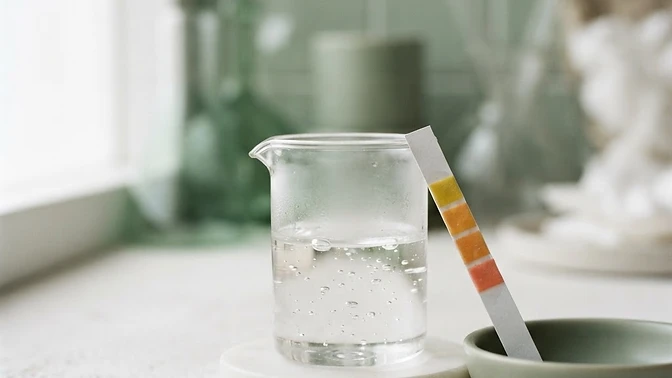
The skin's natural acidity
Healthy skin sits at a pH of roughly 4.7–5.5, the acid mantle. This mildly acidic surface supports the microbiome, activates skin enzymes, and maintains the lipid seal. When a product is formulated far outside this range, it does not just feel different, it changes how the skin behaves.
Why pH governs efficacy
Actives are only effective at specific pH windows, and these are not optional:
- L-ascorbic acid (vitamin C) is most stable and bioactive below pH 3.5. Above pH 4 it oxidises rapidly and penetrates poorly.
- AHAs (glycolic, lactic, mandelic) need pH 3.0–4.0 to exfoliate. At neutral pH they are little more than hydrating humectants.
- Retinoids are stable and effective around pH 5–6.
- Niacinamide performs best near pH 6 and can hydrolyse to nicotinic acid (a flushing irritant) at very low pH.
A beautifully formulated 10% vitamin C at pH 6 is less effective than a 10% vitamin C at pH 3. The ingredient list alone does not tell you what the product does.
When pH goes wrong
High-pH (alkaline) cleansers are the most common offender. A soap-based cleanser at pH 9–10 strips ceramides and disrupts the barrier within days, producing dryness, tightness and reactive sensitivity. This is why sulfate-free, pH-balanced cleansers are the foundation of clinical skincare.
Formulation over marketing
Brands do not print pH on labels, but the serious ones formulate to it. At SK1N we select formulas built at skin-compatible pH so actives remain both effective and gentle. The right molecule, at the right concentration, at the right pH, that is what makes a product work.
FAQ
Frequently Asked Questions
Why doesn't my cleanser feel 'squeaky clean' anymore?+
Because 'squeaky clean' usually meant alkaline. High-pH cleansers strip ceramides and lipids, leaving skin tight and more reactive. A pH-balanced, sulfate-free cleanser leaves skin comfortable — not stripped — and protects the acid mantle that keeps skin healthy.
Can I use vitamin C and AHAs in the same routine?+
They can be used on the same day but generally not in the same application — both require low pH and can overwhelm the barrier together. Vitamin C in the morning, AHAs in the evening is the standard approach. If layering, wait 15–20 minutes for pH to normalise between steps.
Does pH matter for moisturisers?+
Less critically than for cleansers and actives, but yes. A moisturiser formulated near the skin's pH (around 5) supports barrier enzymes and microbiome balance. The real risks sit with cleansers (too alkaline) and actives (wrong pH for the molecule).
How do I know a product's pH?+
Reputable clinical brands publish or formulate to the correct pH. You can also test with pH strips, though the most reliable signal is choosing brands with transparent, evidence-led formulation standards. At SK1N we only stock formulas built at skin-compatible pH.
Is low pH always better?+
No. Low pH is essential for some actives (vitamin C, AHAs) but unsuitable for others (niacinamide prefers near pH 6). The right pH depends on the molecule. 'Low pH' is not a universal virtue — the correct pH for the active is.